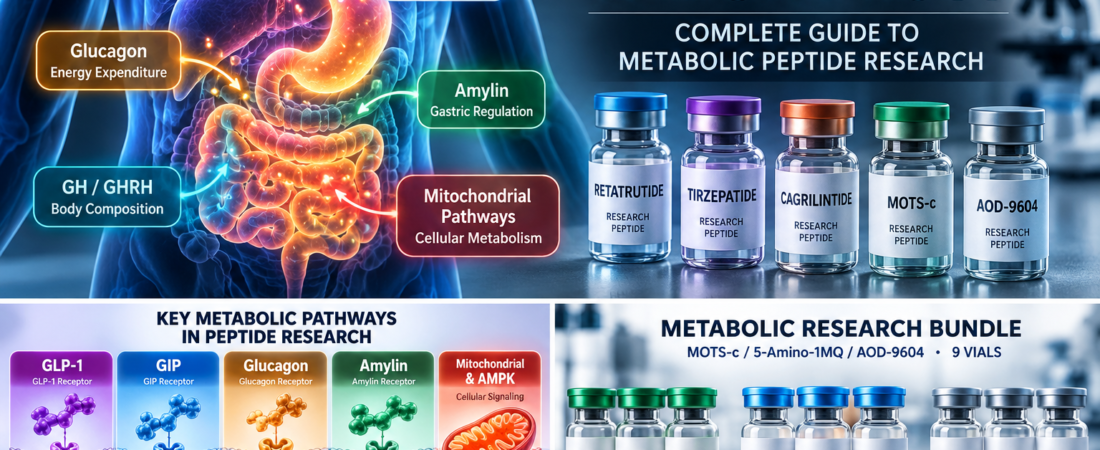
Peptides for weight loss are not one scientific category, and the compounds commonly grouped under that phrase do not all work the same way or have the same level of evidence. Metabolic peptide research includes incretin receptor agonists such as tirzepatide, investigational multi-receptor compounds such as retatrutide, amylin analogues such as cagrilintide, mitochondrial peptides such as MOTS-c, growth-hormone-related compounds, and other experimental metabolic molecules.
For researchers, the important question is therefore not simply which peptide is “best.” A more useful approach is to ask which biological pathway a compound affects, what outcomes have actually been studied, and whether the evidence comes from human trials, animal models, cell studies, or mechanistic hypotheses.
This guide maps the major pathways and compounds involved in metabolic peptide research while separating established clinical evidence from emerging and preclinical findings.
Research-use note: PeptidesLab US catalog products discussed in this guide are supplied for legitimate laboratory and research purposes. A research product should not be assumed to be equivalent to an FDA-approved medicine or intended for human administration.
Key Takeaways
- “Weight loss peptides” is an umbrella search term covering compounds with very different mechanisms and evidence levels.
- GLP-1, GIP, glucagon, and amylin signaling are among the most clinically developed pathways in contemporary metabolic research.
- Tirzepatide has established human clinical evidence and an FDA-approved weight-management indication as the prescription medicine Zepbound.
- Retatrutide targets GIP, GLP-1, and glucagon receptors and has advanced through Phase 3 obesity research, but its regulatory status is different from tirzepatide.
- MOTS-c, AOD-9604, and 5-Amino-1MQ involve different metabolic hypotheses and should not be presented as though their evidence were equivalent to large obesity drug trials.
- For laboratory buyers, compound identity, batch documentation, analytical data, storage, and traceability matter independently of biological research findings.
What Are Peptides?
Peptides are chains of amino acids connected by peptide bonds. They can function as signaling molecules and interact with receptors, enzymes, and other molecular targets involved in biological processes.
Some naturally occurring peptide hormones play major roles in metabolism. Examples include glucagon-like peptide-1 (GLP-1), glucagon, insulin, and amylin. Researchers can investigate natural peptides, synthetic analogues, modified peptide sequences, and compounds designed to activate or inhibit related pathways.
The term weight loss peptide, however, can be misleading when used too broadly.
A compound may appear in metabolic research because it influences appetite signaling, glucose regulation, energy expenditure, adipose biology, mitochondrial function, growth-hormone signaling, or another metabolic pathway. That does not mean every such compound has been demonstrated to cause weight loss in humans.
This distinction is essential when interpreting peptide weight loss research.
Why Are Peptides Studied in Metabolic Research?
Researchers study peptides because metabolism is regulated by interconnected signaling systems rather than by a single “fat-burning” pathway.
After food intake, for example, gastrointestinal and pancreatic signals help regulate satiety, gastric emptying, insulin secretion, glucagon activity, and nutrient handling. Other signaling networks influence adipose tissue, skeletal muscle, liver metabolism, mitochondrial activity, and energy balance.
Modern metabolic research therefore investigates several questions:
- Can appetite and satiety signaling be altered through specific receptors?
- Can multiple metabolic receptors be targeted simultaneously?
- How does glucagon signaling affect energy expenditure?
- How does amylin signaling interact with satiety?
- Can mitochondrial signaling influence metabolic homeostasis?
- How does growth-hormone signaling affect adipose tissue and body composition?
- Can enzymes involved in cellular energy metabolism become experimental metabolic targets?
These questions have produced several distinct research classes that are frequently grouped together online as peptides for fat loss or metabolic peptides.
Major Metabolic Pathways in Peptide Research
GLP-1 Signaling
Glucagon-like peptide-1 is an incretin hormone involved in glucose-dependent insulin secretion, glucagon regulation, gastric function, and appetite-related signaling.
GLP-1 receptor agonism has become one of the most extensively investigated mechanisms in contemporary obesity and metabolic medicine.
The strength of evidence surrounding the pathway is important because it illustrates a central principle of peptide research: mechanistic plausibility and demonstrated human outcomes are not the same thing.
For certain GLP-1-based medicines, large randomized human trials exist. That level of evidence cannot automatically be transferred to unrelated compounds merely because they are marketed or discussed within the same broad “metabolic peptide” category.
GIP Signaling
Glucose-dependent insulinotropic polypeptide, or GIP, is another incretin hormone.
GIP receptor signaling is particularly relevant to research on multi-agonist compounds. Tirzepatide, for example, acts at both GIP and GLP-1 receptors.
This dual-receptor strategy helped expand metabolic research beyond single-receptor GLP-1 agonism and raised broader questions about whether coordinated signaling across several hormonal pathways can produce different metabolic effects.
Glucagon Signaling
Glucagon is traditionally associated with hepatic glucose regulation, but glucagon-receptor biology is also relevant to energy expenditure and broader metabolic physiology.
This pathway has attracted particular attention through triple agonists, most notably retatrutide.
Retatrutide activates GIP, GLP-1, and glucagon receptors, creating a research model that differs mechanistically from both single GLP-1 agonism and dual GIP/GLP-1 agonism.
Amylin Signaling
Amylin is a pancreatic peptide hormone released alongside insulin and involved in satiety and gastric regulation.
Cagrilintide is a long-acting amylin analogue being investigated in metabolic research. A randomized Phase 2 trial evaluated cagrilintide in adults with overweight or obesity, and subsequent research has examined its coadministration with semaglutide.
The amylin pathway therefore represents a separate metabolic research strategy rather than simply another version of GLP-1 signaling.
Growth Hormone and GHRH Signaling
Growth hormone influences multiple tissues and metabolic processes, including lipid metabolism and body composition.
Compounds associated with this research area include growth hormone-releasing hormone analogues and fragments derived from growth-hormone-related sequences.
Tesamorelin and AOD-9604 are often discussed together in online weight-loss-peptide content, but they should not be treated as interchangeable.
Their molecular characteristics, research histories, regulatory contexts, and evidence bases differ substantially.
Mitochondrial and AMPK Signaling
Not all metabolic research compounds work through gastrointestinal hormone receptors.
MOTS-c is a mitochondrial-derived peptide encoded within mitochondrial DNA. Early work identified metabolic effects involving skeletal muscle, insulin sensitivity, and AMPK-related signaling.
Animal research reported effects on metabolic homeostasis and diet-induced obesity, while human research has investigated circulating MOTS-c and its relationship to metabolic states.
These observations make MOTS-c scientifically interesting, but they do not establish it as a clinically proven human weight-loss treatment.
NNMT and NAD+ Metabolism
5-Amino-1MQ belongs to another mechanistic category.
It is a small-molecule inhibitor associated with research into nicotinamide N-methyltransferase, or NNMT. NNMT participates in nicotinamide metabolism and has become a research target in metabolic biology.
Recent animal research involving an NNMT inhibitor reported changes in body composition and metabolic variables in diet-induced obese mice.
This is a good example of why evidence classification matters: promising results in an animal obesity model remain preclinical evidence, not proof of a human weight-management effect.
Major Compounds in Metabolic and Weight Research
Retatrutide
Retatrutide is an investigational triple receptor agonist targeting:
- GIP receptors
- GLP-1 receptors
- glucagon receptors
Its three-receptor profile distinguishes it from tirzepatide’s dual GIP/GLP-1 mechanism.
A randomized Phase 2 obesity trial published in The New England Journal of Medicine in 2023 established substantial clinical interest in the compound. The research program subsequently advanced, and positive topline results from the Phase 3 TRIUMPH-1 trial were announced in 2026.
That makes retatrutide one of the most advanced investigational compounds in metabolic research.
It remains important, however, to distinguish positive clinical trial results from regulatory approval. Investigational status and FDA approval are separate questions.
Tirzepatide
Tirzepatide is a dual GIP and GLP-1 receptor agonist.
Unlike many compounds discussed under the “research peptides for metabolism” umbrella, tirzepatide has extensive randomized human evidence.
The SURMOUNT-1 program studied tirzepatide in adults with obesity or overweight and demonstrated substantial sustained body-weight reductions. Longer-term research has also examined outcomes in participants with obesity and prediabetes.
In November 2023, the FDA approved Zepbound, which contains tirzepatide, for chronic weight management in qualifying adults.
Researchers and buyers should nevertheless distinguish the FDA-approved prescription drug from laboratory research materials containing or labeled as tirzepatide. Regulatory approval of a medicine does not automatically confer approved-drug status on a research product.
Cagrilintide
Cagrilintide is a long-acting amylin analogue.
Its mechanism provides an important contrast to incretin-based approaches because it centers on amylin-related satiety signaling.
Phase 2 randomized research evaluated cagrilintide as a weight-management candidate. More recently, cagrilintide has been investigated alongside semaglutide.
The Phase 3 REDEFINE 1 study of cagrilintide-semaglutide included more than 3,000 randomized participants and further expanded the human evidence surrounding amylin/GLP-1 combination research.
For a metabolic research hub, the main takeaway is not that cagrilintide is “better” or “worse” than a GLP-1-based compound. It demonstrates that researchers are investigating different hormonal pathways and combinations to influence energy balance and satiety.
AOD-9604
AOD-9604 is a synthetic analogue based on a lipolytic region of human growth hormone.
Early published research investigated its metabolic activity in obese animal models. In obese Zucker rats, researchers reported changes in weight gain and adipose-tissue lipolytic activity.
That evidence is substantially different from the large randomized obesity trials available for compounds such as tirzepatide.
AOD-9604 therefore illustrates one of the most common problems with “peptides for fat loss” discussions: mechanistic or animal findings can be repeated online until they begin to sound like established clinical outcomes.
They are not equivalent.
Researchers should examine the experimental model, endpoints, study design, and human evidence separately before drawing conclusions.
MOTS-c
MOTS-c, or mitochondrial open reading frame of the 12S rRNA type-c, is a mitochondrial-derived peptide associated with metabolic signaling.
A landmark 2015 Cell Metabolism paper reported that MOTS-c influenced metabolic homeostasis and insulin sensitivity in experimental models, including effects involving skeletal muscle and AMPK signaling.
Research has continued to investigate MOTS-c in metabolic stress, exercise, mitochondrial function, and human metabolic states.
Importantly, human studies measuring endogenous circulating MOTS-c are not equivalent to clinical trials showing that administered MOTS-c produces weight loss.
That distinction should remain explicit whenever MOTS-c is discussed as a metabolic research peptide.
5-Amino-1MQ
5-Amino-1MQ is commonly grouped with metabolic peptides, although chemically it is better described as a small-molecule research compound, not a peptide.
Its primary research interest involves NNMT inhibition.
Preclinical studies have investigated NNMT inhibition in adipose and metabolic biology. A 2024 animal study of 5A1MQ in diet-induced obese mice reported effects involving body composition, glucose handling, insulin sensitivity, and liver metabolic parameters.
Those findings support continued mechanistic investigation. They do not establish clinical weight-loss efficacy in humans.
Correctly classifying 5-Amino-1MQ is one simple way to improve the scientific precision of metabolic research content.
Tesamorelin
Tesamorelin is a growth hormone-releasing hormone analogue.
Its research and clinical context differs substantially from GLP-1/GIP agonists, amylin analogues, mitochondrial peptides, and NNMT inhibitors.
It is often included in online lists of “fat loss peptides,” but broad categorization can obscure the specific population, endpoints, and regulatory indication associated with tesamorelin research.
Researchers should therefore distinguish changes in visceral adipose tissue or body composition from general obesity treatment or overall body-weight reduction.
Comparing Metabolic Research Compounds
| Compound | Research class | Main pathway | Evidence context |
|---|---|---|---|
| Tirzepatide | Dual incretin agonist | GIP + GLP-1 | Extensive human Phase 3 evidence; approved prescription medicine for specified indications |
| Retatrutide | Triple receptor agonist | GIP + GLP-1 + glucagon | Advanced human clinical research; investigational |
| Cagrilintide | Amylin analogue | Amylin signaling | Human clinical research |
| AOD-9604 | GH-fragment analogue | GH-related/lipolytic research | Earlier experimental and limited clinical research; evidence should not be equated with modern Phase 3 obesity programs |
| MOTS-c | Mitochondrial-derived peptide | Mitochondrial/AMPK-related signaling | Strong mechanistic and preclinical interest; limited human intervention evidence |
| 5-Amino-1MQ | Small molecule, not peptide | NNMT inhibition | Primarily preclinical metabolic research |
| Tesamorelin | GHRH analogue | GH/GHRH axis | Human clinical evidence in a specific body-composition context |
The table reveals why a single ranking of “best weight loss peptides” can be scientifically misleading.
These compounds are not competing versions of one mechanism. They belong to different research categories, have different endpoints, and sit at different stages of evidence development.
What Does Current Research Show?
The strongest human evidence within this broad field currently belongs to incretin-related and certain amylin-related approaches.
Tirzepatide has large randomized trials and an established regulatory pathway. Retatrutide has progressed from published Phase 2 research to positive Phase 3 results, while cagrilintide has been studied independently and in combination with semaglutide.
By comparison, the evidence surrounding compounds such as MOTS-c and 5-Amino-1MQ remains much more mechanistic or preclinical.
That does not make early-stage research unimportant.
Preclinical experiments can identify pathways, generate hypotheses, and justify further investigation. But a cell experiment, rodent study, observational human study, randomized clinical trial, and FDA approval answer fundamentally different scientific questions.
A Practical Evidence Hierarchy
When evaluating claims about metabolic research peptides, ask:
- Was the finding demonstrated in vitro?
- Was it reproduced in an animal model?
- Have human observational data been collected?
- Has the compound undergone controlled human intervention trials?
- Were trials randomized and adequately powered?
- Has the evidence been independently replicated?
- Has a regulator evaluated a specific medicine for a specific indication?
A compelling molecular mechanism is the beginning of an evidence story, not the end.
Research Compounds vs FDA-Approved Weight-Management Drugs
This is one of the most important distinctions in the entire topic.
An FDA-approved drug has undergone regulatory evaluation for specific indications, manufacturing standards, labeling, and benefit-risk considerations.
A laboratory research compound is supplied for experimental or analytical investigation.
Those categories should never be blurred.
For example, tirzepatide is the active ingredient in FDA-approved Zepbound. That fact does not mean every product containing or described as tirzepatide is itself an FDA-approved drug.
Similarly, positive retatrutide clinical-trial results do not mean research retatrutide has become an approved medicine.
For laboratory procurement, researchers should evaluate the actual product being purchased rather than borrowing regulatory claims from a pharmaceutical medicine or clinical-trial preparation.
Peptide Purity, COAs, and Research Quality
Biological literature answers one question: What has science reported about this compound?
Product documentation answers another: What material is actually in this specific research vial or batch?
Researchers should not confuse the two.
A Certificate of Analysis, or COA, may provide analytical information associated with a particular batch. Depending on the documentation and methods used, relevant information can include compound identity, assay or purity data, lot information, and analytical results.
Important laboratory procurement considerations include:
- correct compound identity
- batch or lot traceability
- analytical documentation
- stated quantity
- storage requirements
- product format
- appropriate labeling
- supplier transparency
PeptidesLab US notes that documentation varies by product and advises researchers to check individual listings for available batch information.
A product’s scientific reputation does not replace batch-level verification.
Laboratory Storage Considerations
Peptides and related research compounds can differ in stability, solubility, and handling requirements.
Storage conditions may be affected by:
- whether material is lyophilized or in solution
- temperature
- exposure to light
- moisture
- pH
- solvent selection
- repeated temperature cycling
- compound-specific stability characteristics
Researchers should therefore follow product-specific documentation rather than assuming every peptide can be stored identically.
PeptidesLab US provides a dedicated Storage & Reconstitution resource for laboratory handling information, while individual product pages should be checked for compound-specific instructions.
Metabolic Research Bundle
For researchers comparing several non-incretin metabolic pathways, PeptidesLab US currently lists a Metabolic Research Bundle containing:
- 3 × MOTS-c 10 mg
- 3 × 5-Amino-1MQ 50 mg
- 3 × AOD-9604 5 mg
The compounds represent three different areas of metabolic investigation: mitochondrial signaling and cellular energy metabolism, NNMT/NAD+-related pathways, and GH-fragment/lipolysis research.
This grouping can be useful for comparative laboratory research, but the compounds should not be interpreted as having equivalent mechanisms or evidence.
The product is supplied for research purposes, and batch-specific documentation should be reviewed for the individual compounds.
Frequently Asked Questions
What peptides are studied for weight loss?
Research spans several classes, including GLP-1 receptor agonists, dual GIP/GLP-1 agonists, triple GIP/GLP-1/glucagon agonists, amylin analogues, growth-hormone-related peptides, and mitochondrial-derived peptides. Evidence strength varies dramatically among these categories.
How do GLP-1 peptides affect metabolic signaling?
GLP-1 receptor signaling influences glucose-dependent insulin secretion, glucagon regulation, gastric function, and appetite-related pathways. GLP-1-based pharmacology has extensive human clinical evidence, but findings from approved medicines should not automatically be generalized to unrelated research peptides.
What is the difference between tirzepatide and retatrutide?
Tirzepatide activates GIP and GLP-1 receptors. Retatrutide activates those two receptors plus the glucagon receptor, making it a triple agonist. Tirzepatide has FDA-approved indications, while retatrutide remains an investigational compound as of 2026.
Is MOTS-c a GLP-1 peptide?
No. MOTS-c is a mitochondrial-derived peptide. Its research centers on metabolic homeostasis, cellular stress responses, skeletal muscle, mitochondrial biology, and pathways including AMPK rather than GLP-1 receptor agonism.
Is 5-Amino-1MQ a peptide?
No. 5-Amino-1MQ is a small-molecule research compound associated with NNMT inhibition. It is frequently discussed alongside metabolic peptides because of the research area rather than because it is chemically a peptide.
What does a peptide COA show?
A Certificate of Analysis provides analytical information associated with a product or batch. The exact information depends on the testing performed. Researchers should examine the analytical methods, batch identifiers, reported results, and whether the document corresponds to the material being purchased.
Are research peptides the same as prescription weight-loss medications?
No. A laboratory research product and an FDA-approved prescription medicine are different regulatory and product categories, even when discussions involve the same molecular name.
Why is evidence stage important in metabolic peptide research?
Evidence stage tells researchers how confidently a finding can be interpreted. In-vitro experiments, animal studies, observational human research, randomized clinical trials, and regulatory approvals provide different types and strengths of evidence. Preclinical findings should not be presented as established human outcomes.
Conclusion
The science behind peptides for weight loss is better understood as a collection of metabolic research pathways than as a list of interchangeable fat-loss compounds.
GLP-1, GIP, glucagon, and amylin pathways now have substantial human research behind them. Tirzepatide has reached approved clinical use for defined indications, while retatrutide represents an advanced investigational triple-agonist strategy. Other compounds, including MOTS-c, AOD-9604, and 5-Amino-1MQ, occupy very different positions on the evidence spectrum.
For researchers, that distinction is crucial.
The most useful comparison is not simply which compound generates the most attention. It is what biological pathway is being investigated, what experimental model produced the evidence, how strong that evidence is, and whether the material being studied has adequate identity, documentation, and traceability.
That evidence-first framework provides a more accurate foundation for understanding modern metabolic peptide research.
References
- Jastreboff AM, et al. Tirzepatide Once Weekly for the Treatment of Obesity. New England Journal of Medicine. 2022. DOI: 10.1056/NEJMoa2206038.
- Jastreboff AM, et al. Triple-Hormone-Receptor Agonist Retatrutide for Obesity — A Phase 2 Trial. New England Journal of Medicine. 2023. DOI: 10.1056/NEJMoa2301972.
- Lau DCW, et al. Once-weekly cagrilintide for weight management in people with overweight and obesity. The Lancet. 2021.
- Garvey WT, et al. Coadministered Cagrilintide and Semaglutide in Adults with Overweight or Obesity. New England Journal of Medicine. 2025. DOI: 10.1056/NEJMoa2502081.
- Lee C, et al. The mitochondrial-derived peptide MOTS-c promotes metabolic homeostasis and reduces obesity and insulin resistance. Cell Metabolism. 2015. DOI: 10.1016/j.cmet.2015.02.009.
- Ng FM, et al. Metabolic studies of a synthetic lipolytic domain (AOD9604) of human growth hormone. Hormone Research. 2000. DOI: 10.1159/000053183.
- FDA Approves New Medication for Chronic Weight Management. U.S. Food and Drug Administration. November 8, 2023.